





Live sports streaming always comes with a simple truth: the moments that matter most are also most likely to be targeted by attackers. For operators, that creates constant pressure to protect premium content without adding risk to the live experience.
Piracy tactics are evolving. More advanced attacks can extract encryption keys from compromised environments, which means exposure can happen during the live window.
The industry has long understood the principle: frequent key rotation shortens the useful life of a leaked key. But in live sports, applying that at scale is difficult because key rotation can create operational strain at exactly the moments when services need to be most stable.
Scaling constraint behind frequent key rotation
When an encryption key is refreshed, large numbers of devices that are already watching the stream may request access to the next key at roughly the same time. In practice, those requests often cluster into a very small window, sometimes just seconds, because devices are requesting the next key close to playback.
This creates a “license storm” problem (often also described as a “thundering herd”). Instead of a steady flow of license traffic, operators see sharp peaks at key‑rotation boundaries. During high‑profile sports events, with audiences reaching hundreds of thousands or even millions of simultaneous viewers, those peaks can become extreme.
Operators could scale infrastructure to absorb those periodic spikes, but doing so is expensive, complex and risky. This is why frequent key rotation has remained a stubborn industry challenge for so long. The question is not whether stronger protection is needed, but how to deliver it in a way that works reliably under live‑event conditions.
Viable model starts with three requirements
A practical approach should be measured against three requirements for a live-event scale.
- Scalable key rotation: Enable shorter key rotation intervals without requiring operators to scale DRM endpoint infrastructure for every rotation event.
- Low-friction deployment: Be low-friction to adopt, avoiding infrastructure changes wherever possible, especially packagers and players.
- Standards and ecosystem fit: Work within existing standards and ecosystem capabilities, including established streaming formats and DRM workflows.
New way of handling frequent key rotation
If frequent key rotation creates request spikes, the solution is to spread license demand more effectively and reduce request concentration.
This is the deployment model behind Irdeto Control’s High-Frequency Key Cycling approach, and it combines two mechanisms:
- Provide current and future keys in the same license response: Where supported, this reduces how often devices need to request new licenses during a live stream.
- Stagger subsequent requests using device groups (shards): Devices are assigned to groups, and each group requests future keys at different times.
These mechanisms address different parts of the same problem: future keys reduce request frequency, and sharding spreads the remaining requests over time. Together, they smooth traffic patterns and reduce boundary-driven spikes.
What this looks like during a major live event
Consider a popular event with 1,000,000 viewers and a 10-minute crypto period. If devices request the next key close to playback, license requests can concentrate in a very small window at the crypto period boundary, requiring massive and expensive scaling.
Figure 1 illustrates this baseline pattern. After audience ramp-up, each key rotation boundary can trigger a new license storm, creating short, sharp peaks in request volume. In practice, that means infrastructure must be sized for boundary-driven spikes rather than typical traffic levels.
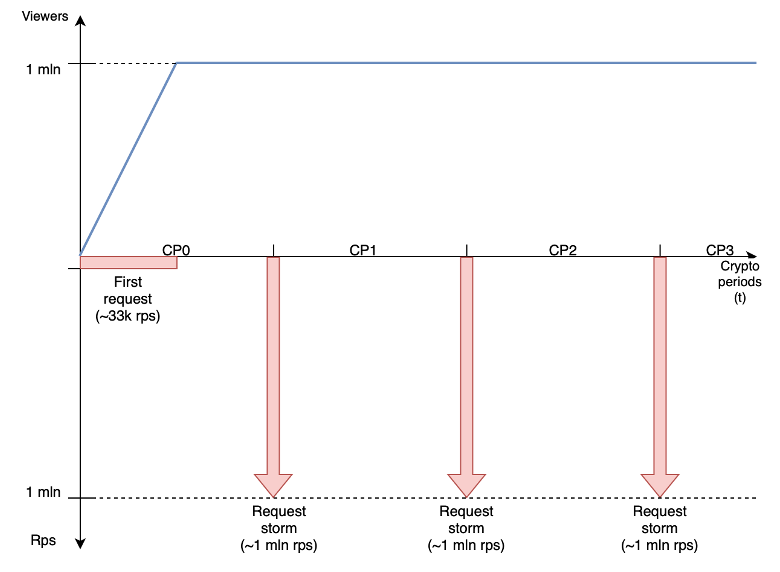 Figure 1. Example request concentration at crypto period boundaries in a large live event (without mitigation).
A practical mitigation changes that pattern by combining future key delivery with shards to stagger license requests. Devices do not need to fetch every new key, and the remaining requests are distributed across groups instead of arriving at the same moment.
Figure 2 shows the effect in the same scenario when devices receive current and future keys and are split into shards. The result is lower request concentration at each boundary and a smoother license traffic profile across the event.
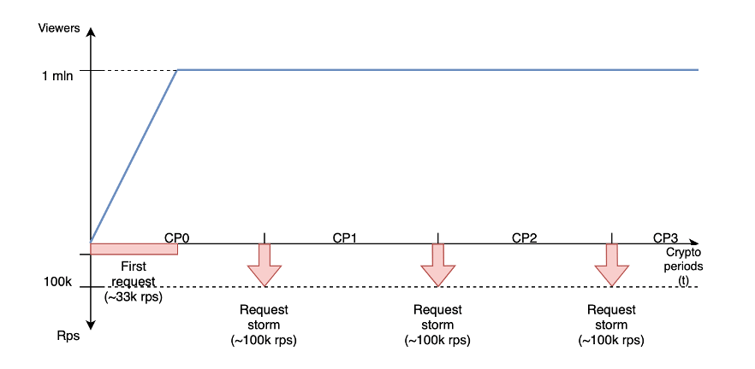 Figure 2. Example reduction in license storm intensity using future key delivery and device groups (shards) to stagger license requests.
In other words, the model reduces license storms by changing both how often devices request licenses and when they request them.
Grouping quality matters
Shards only help if they stagger license requests in a predictable and balanced way. This depends on a grouping method that can reliably distribute devices across shards.
To reduce license storms effectively, the groups need to be reasonably even in size. If one group is much larger than the others, traffic concentration simply shifts rather than improving.
In short, shards make staggered license requests practical by turning a synchronized demand spike into a more controlled and distributed traffic pattern.
Putting frequent key rotation to work at scale
For teams running live sports streaming, the challenge now is execution: strengthening protection without creating new operational pressure during the moments that matter most. Stronger key rotation matters, but only if it can be deployed without adding operational fragility.
Irdeto Control's High-Frequency Key Cycling solution is designed for exactly that. It is built around the same traffic-smoothing model described above: reducing boundary concentration, so frequent key rotation is easier to support at scale.
If this perspective aligns with how you are thinking about live sports content protection, we invite you to continue the conversation with Irdeto’s experts and explore what this shift could mean for your organization.









/Images/Module%20-%20footer/spiral.svg)


