





For media entertainment platforms, a live event does not wait for the next report.
Audiences arrive together, attention peaks quickly and every decision has a short shelf life. If a viewer cannot find the event, the opportunity to engage is already being lost. If monetization disrupts the experience, the value of that attention falls. If engagement signals are only understood after the final whistle, the platform has missed the moment when intent was strongest.
That is why business intelligence in live sports cannot stop at explaining performance after the event. It needs to help platforms understand what is happening across access, viewing, monetization and engagement while there is still time to act.
The real challenge is decision readiness
The real problem is not a lack of data. Most platforms already generate abundant signals across onboarding, discovery, consumption and monetization.
The challenge is whether those signals can be connected quickly enough to support a live event. Playback data may show rising buffering and errors, monetization data may show weaker performance signals, entitlement data may explain why some viewers cannot access the stream, and engagement data may point to early drop-off. If those signals sit in separate systems, teams see pieces of the same event rather than the whole picture.
The cost of that fragmentation is speed. A content team may see strong interest in an event, a product team may see friction in discovery or playback, and a commercial team may see mixed ad performance. Without a shared view, each team optimizes its own part of the experience while the live opportunity continues to move.
In on-demand streaming, delayed insight may simply slow optimization. In live sports, the impact is more immediate: engagement can drop, monetization windows can close and the opportunity to act may be gone before the event is over.
Decision windows in live sports
A live sports event is not a single decision point. It is a sequence of decisions, each with its own timing and consequences. Before, during and after the event, platforms need to act on different information while the commercial and engagement opportunity is still open.
Before the event, rights, entitlement rules and discovery need to work together, so viewers can find and access the content they are entitled to watch. During the event, the focus shifts to protecting attention and monetizing without disrupting the experience. After the event, the challenge becomes turning clear signals of intent into the next reason to return, so sports becomes a driver of continued engagement rather than a short-lived spike.
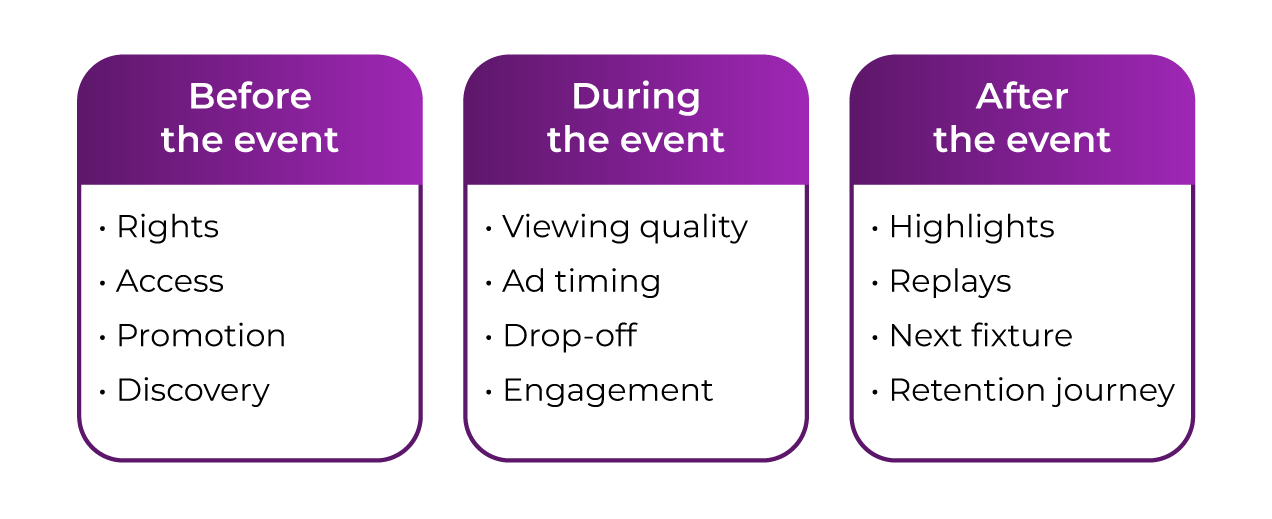
Figure 1. BI helps platforms connect the right signals before, during and after an event, from rights, access and discovery to viewing quality, monetization, engagement and retention.
Before the event: make rights visible and accessible
Rights only create value when they work within the user journey. A platform may own the rights, but that value is weakened if the event is hard to find, promoted in the wrong region, blocked on the wrong device or shown to users who are not entitled to watch it.
That makes rights management part of the platform experience, not just a commercial or legal process. Before the event, BI should help teams see whether rights, promotion and discovery are working together or introducing avoidable friction.
During the event: protect attention while monetizing
Live sports creates focused attention, but only for a limited window. That makes monetization a matter of timing, context and execution. More ads do not automatically create more value, especially when viewers have little patience for disruption.
During a live event, BI should show whether monetization is working with the viewing experience or against it: which formats hold attention, where drop-off begins, whether playback issues are affecting ad performance, and where revenue can be increased without weakening the experience.
After the event: turn intent into the next reason to return
The long-term value of live sports depends on what the platform learns and does next. When a user watches a team, league, tournament, highlight package or replay, they are giving the platform a clear signal about what may bring them back.
The post-event window is where platforms learn whether sports created a relationship or just a visit. BI should help turn that clear intent into the next action: a replay, a highlight, a related upcoming event, adjacent entertainment content or a retention journey that gives the viewer a reason to come back.
This is where entertainment platforms built around sports either turn event-driven spikes into sustained growth or allow engagement to fade until the next major event.
One source of data visibility
Live sports needs more than isolated dashboards. It requires a shared data foundation across the organization, so decisions are shaped by one trusted view of the event, not multiple versions of the truth.
That does not mean every team needs to see the data in the same way. Content teams may look for patterns across events, rights and formats. Monetization teams will care more about ad performance and revenue opportunities. Product teams need to understand the viewer experience across devices, from discovery and access to playback quality. Leadership needs the broader picture, across engagement, regional performance, revenue and retention.
The real value of BI is in bringing these perspectives together without creating different versions of the truth. Rights, playback, engagement, monetization and retention data should all come from the same foundation, while the way each team sees and uses that data should reflect the decisions they need to make.
For Irdeto Experience, this is why business intelligence cannot be treated as a reporting layer that sits outside the streaming platform. It needs to be embedded in the live sports experience itself, connected to what users can access, how they watch, where value is created and where friction starts to build.
From reporting to competitive advantage
Live sports does not reward delay. By the time a post-event report explains what happened, the viewer has moved on, the ad opportunity is gone and the next engagement decision should already have been made.
The platforms that create the most value from sports will be the ones that connect rights, viewing behavior, monetization and retention signals while there is still time to act on them.
That is the point at which business intelligence stops being a report on performance and becomes part of how the platform competes.
If you are exploring how to connect live sports data more directly to platform decisions, get in touch with Irdeto Experience to continue the conversation.








/Images/Module%20-%20footer/spiral.svg)


