





The risks facing gaming communities today are not new to those working in the industry. Exploitation, grooming, harassment and exposure to harmful ideologies have existed in online spaces for years. What has changed is how these risks appear, and how easily they blend into everyday activity.
Games are no longer just products. They are social environments where people communicate, create and spend time together. Millions of players interact daily, often across age groups and cultures. At that scale, harmful behavior does not always show up as a clear violation. More often, it develops gradually.
When similar issues surface repeatedly, they can lose their ability to stand out. Not because they are accepted, but because they no longer seem exceptional. Systems designed to respond to individual incidents become strained when risk is continuous rather than occasional.
This is why gaming platform safety today depends not only on catching obvious problems, but on understanding how behavior changes over time.
What’s changing in online risk management in gaming
Much of today’s misuse does not resemble abuse at first glance.
Conversations often begin casually. Humor and role-play blur intent. Interactions unfold slowly, across multiple sessions or features. A single message, image or interaction may look harmless on its own.
For example, a player might join a social game, participate in chats and form connections around shared interests. Over time, conversations can shift, encouraging private communication, introducing inappropriate topics or testing boundaries. None of these moments alone necessarily raise concern. The risk becomes visible only when the pattern is viewed as a whole.
This creates a growing gap between how risk develops in practice and how it is traditionally detected. Tools designed to flag explicit content or single infractions struggle when harm is behavioral, contextual and cumulative. This remains a defining challenge in online risk management in gaming today.
How risk now tends to surface
Across gaming ecosystems, several patterns appear consistently.
- Signals are less obvious: Harmful influence is rarely direct. It is often wrapped in jokes, memes or fictional scenarios that resemble normal play or banter. Meaning depends on context rather than keywords.
- Behavior is distributed: Instead of one clear incident, risk unfolds across many small actions. Each step may seem acceptable on its own. Together, they can reveal escalation or intent.
- Boundaries between platforms are thin: Interactions rarely stay in one place. A conversation may begin in a game, continue elsewhere and move again. Each service sees only part of the picture.
These dynamics explain why reviewing content one item at a time, while still necessary, is no longer enough on its own.
Where pressure consistently builds
Certain areas within gaming environments are more likely to be misused, not because platforms neglect them, but because they offer opportunity.
Extremist and violent influence
Rather than relying on obvious symbols or slogans, harmful ideologies are often introduced through humor, irony or “edgy” role-play. Over time, repeated exposure can normalize extreme ideas, especially for younger or isolated players. Intent is rarely clear in a single exchange.
Child safety in creative environments
Games that allow players to create content or socialize freely are highly engaging, particularly for minors. That same openness can be exploited. A custom map, avatar or in-game event may appear playful, yet include themes or interactions that are not age-appropriate. Risk emerges through repetition and persistence, not one overt moment.
Limits of isolated moderation
Some harmful behavior is deliberately fragmented. One message may comply with the rules. One asset may be acceptable. But when the same users, themes or interactions recur, a broader pattern can emerge. Reviewing items in isolation makes that harder to detect.
Movement across services
Misuse often spans multiple platforms. When behavior shifts from one space to another, early warning signs can be missed, even when individual platforms take action.
These are not rare edge cases. They are predictable outcomes of large, open, social systems.
Where focus is shifting as risk evolves
As misuse adapts, effective online risk management in gaming depends less on adding new controls and more on using existing capabilities more thoughtfully. The emphasis is shifting toward understanding behavior, context and coordination rather than responding to isolated incidents. This approach reflects how misuse actually develops across platforms and communities.
Early context from public sources
Monitoring open, publicly available information helps surface emerging risks before they become visible inside gaming environments. External signals often provide early insight into evolving tactics, audience building and coordination patterns that later move into games.
Understanding behavior in smaller spaces
Some forms of misuse only become apparent within semi-private groups or limited-access interactions. Careful and ethical analysis of these environments helps identify how behaviors evolve while avoiding unnecessary intrusion into normal player activity.
Adaptive automated detection
Automated systems remain essential for gaming platform safety, but static rules lose effectiveness quickly. Detection improves when systems adapt continuously to real-world patterns, incorporating behavioral signals and interaction data rather than relying solely on fixed indicators.
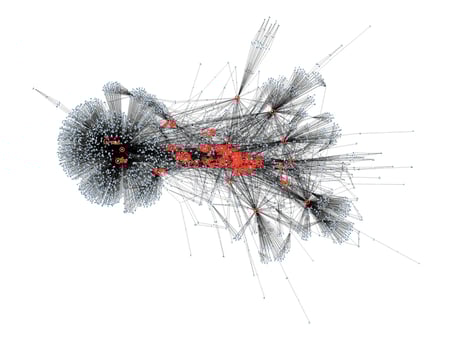
Figure 1 – Highlights: This image shows accounts interacting with flagged user-generated content on a major creative platform. Cluster analysis highlights users likely belonging to the same coordinated group, shown in red, based on shared interaction patterns.
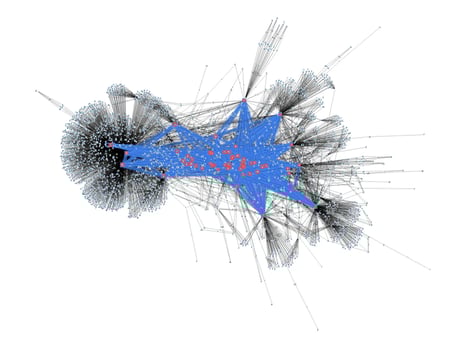
Figure 2 – Cluster + highlights: This view builds on the same analysis by showing the connections between flagged users in blue. Visualizing these relationships helps surface coordination that individual reports or single events may not reveal.
Seeing connections, not just incidents
By examining relationships and repetition across interactions, network-based analysis connects individual signals into a broader behavioral picture. This enables the identification of coordinated activity and supports the discovery of new users or content linked to emerging risks.
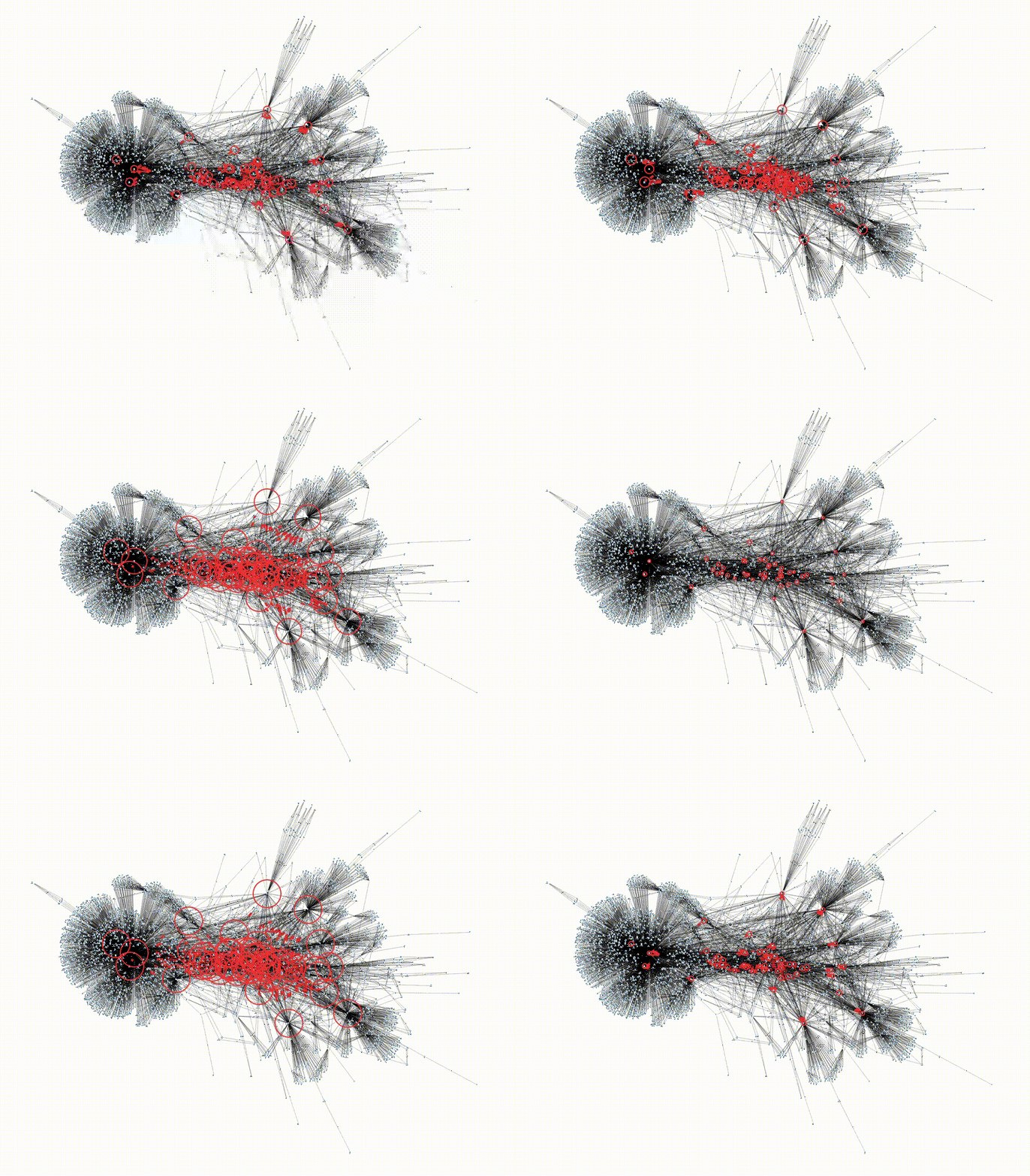
Figure 3 – Network flows: The animation introduces directionality to these interactions, showing how activity propagates across the network over time. Directional flows provide additional insight into how coordination develops and evolves.
Together, these approaches support player protection and platform integrity by aligning detection strategies with real-world behavior. This operational perspective is shared by experienced practitioners across the industry, including teams at Denuvo by Irdeto, who work alongside developers and publishers to help gaming ecosystems remain resilient as external misuse evolves.
Staying alert as risk evolves
What makes these challenges difficult is not a lack of effort, but the way misuse adapts. As gaming environments become more social and interconnected, harmful behavior can grow quieter, more distributed and easier to overlook.
The key takeaway is simple: risk does not disappear when it becomes familiar, it just becomes harder to see. Staying ahead means continuously reassessing how misuse shows up in practice and not only how it is defined on paper.
If this perspective aligns with how you view these challenges, and you are exploring ways to strengthen resilience across gaming ecosystems, please reach out via our Denuvo by Irdeto website.









/Images/Module%20-%20footer/spiral.svg)


