





Competitive games rely on a simple principle: outcomes should reflect player skill. In fast-paced genres, precision, timing and decision-making define success.
That assumption is becoming harder to sustain.
A new generation of AI-assisted cheats is changing how unfair advantage is created and, more importantly, how it is concealed. What once required visible manipulation of the game now increasingly operates through external systems designed to mimic legitimate player behavior.
For developers and publishers, this shifts the problem. It is no longer only about detecting known cheats and how they interact with the game process, but about maintaining trust when cheating becomes harder to see.
Fairness is a player experience, not just a control system
Competitive integrity depends on player confidence.
When players trust the experience, they accept outcomes and remain engaged. When that trust weakens, even slightly, the experience changes. Suspicion replaces certainty, and repeated exposure to questionable gameplay reduces long-term engagement.
This has direct consequences. Players spend less time and money in environments they perceive as unfair, and many begin to disengage entirely.
In competitive ecosystems, perception scales quickly. A relatively small number of undetected cases can influence how the wider player base experiences the game.
Competitive integrity is a business priority
The impact of cheating extends far beyond gameplay quality.
Unchecked cheating directly affects retention, engagement and revenue:
- Players disengage when outcomes feel unfair
- Competitive modes lose credibility and participation
- In-game economies and monetization models come under pressure
- Brand trust erodes over time
Industry data shows how widespread the concern has become. In a Denuvo by Irdeto and Omdia survey, 79% of developers identified cheating as a major or moderate concern, with a similarly high share linking security issues directly to player churn and revenue impact.
As games become more competitive and service-driven, fairness is no longer a secondary consideration. It is a core driver of player confidence and long-term value.
How cheating has evolved
The core cheat categories remain familiar, but their implementation has evolved significantly.
In competitive shooter environments, cheats typically fall into four groups:
- Mechanical cheats: aimbots, triggerbots, anti-recoil, movement scripts (e.g. auto-strafe, bunny-hop)
- Information advantages: wallhack/ESP, radar hacks, visual overlays
- Game-state manipulation: techniques like backtracking to exploit latency
- Cosmetic manipulation: skin changers and non-gameplay modifications
What has changed the most significantly is how mechanical cheats are delivered, bridging traditional techniques with new external and AI-driven approaches.
Modern cheats increasingly operate outside the game client, using computer vision to analyze rendered frames and inject inputs at the system or hardware level. This includes external devices and input automation that bypass traditional software checks.
AI extends this further. Models trained on gameplay data reproduce human-like aim patterns, reaction times and micro-adjustments. Instead of perfect accuracy, they introduce controlled variation to remain within expected human behavior.
The result is a clear shift: the most relevant indication of cheating is no longer in the code, but in how the player interacts with the game.
Why detection models are under pressure
Existing anti-cheat strategies remain effective against direct manipulation. Client integrity checks, anti-tamper controls and signature-based detection continue to identify many forms of cheating.
However, they rely on visibility into the game environment.
When cheats operate externally and avoid modifying the game process, that visibility is reduced. At the same time, AI-assisted inputs can stay within human-like thresholds, avoiding detection designed for more obvious patterns.
This creates a gap. Cheating becomes subtle enough to avoid detection, but still significant enough to affect gameplay.
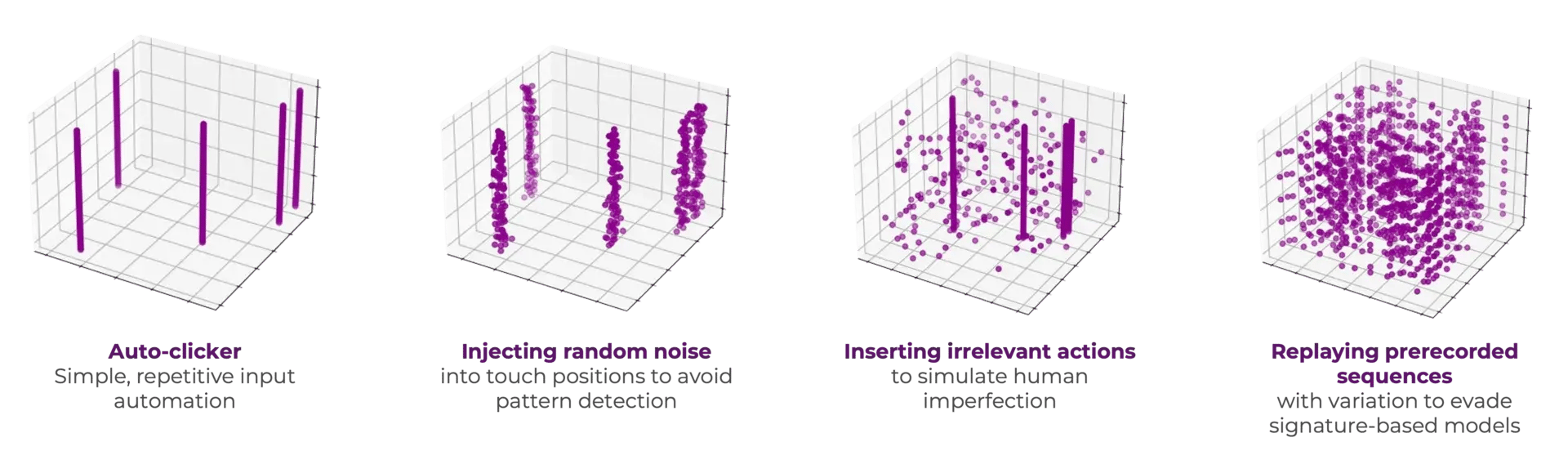
Figure 1. Bots evolve by adding variability, noise and imitation to bypass static detection models and appear human.
Behavior as a detection signal
As cheating shifts, detection must adapt.
Human gameplay is inherently inconsistent. Even highly skilled players show variation in timing, movement and input patterns. AI systems attempt to replicate this, but still produce measurable regularities over time.
Behavioral analysis focuses on these differences.
By evaluating how players interact with the game, such as aim trajectories, reaction timing and repetition patterns, it becomes possible to detect anomalies even when no software modification is visible.
Analyzed in real time and correlated across multiple signals, these patterns provide a reliable way to identify subtle assistance that would otherwise remain undetected.
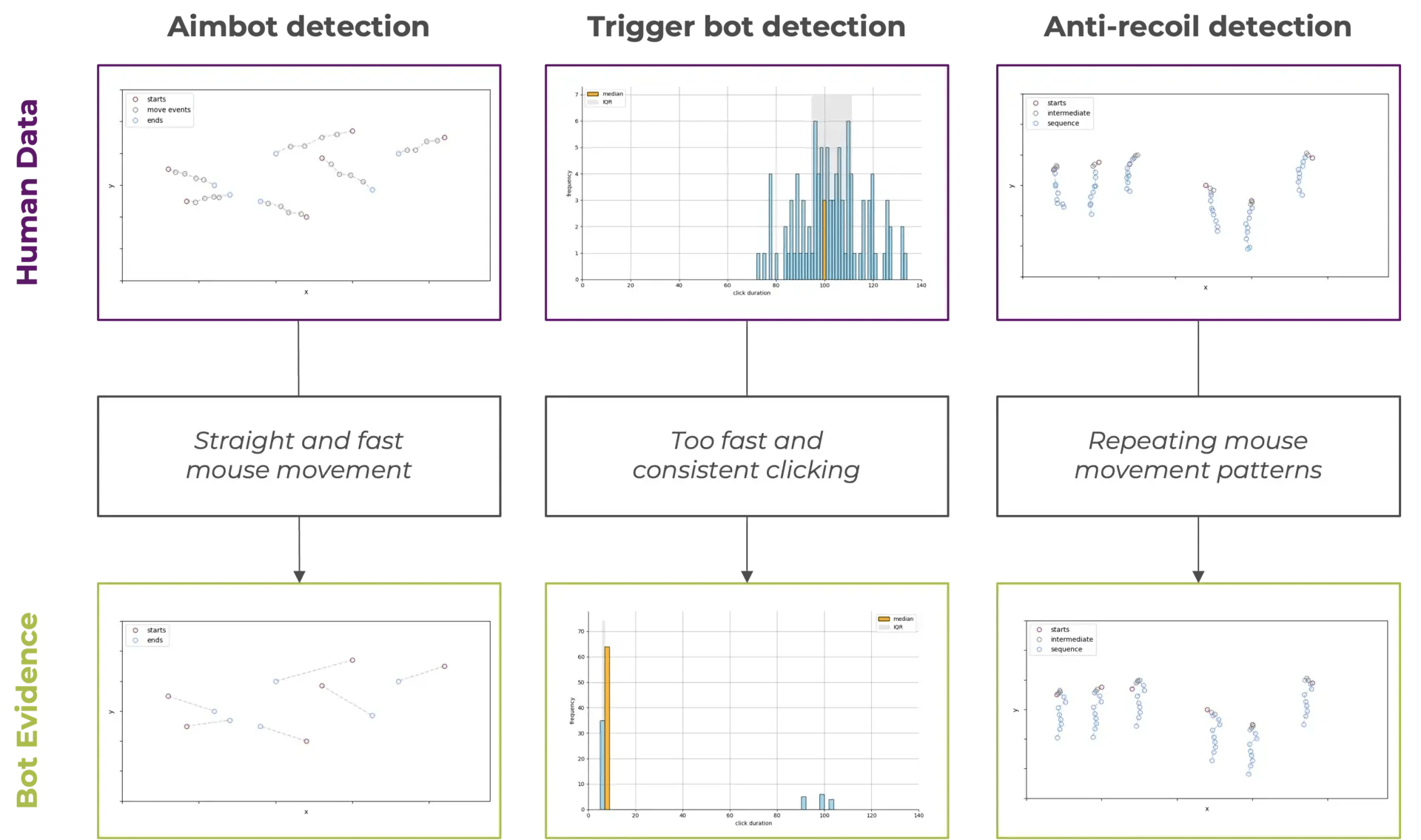
Figure 2. Behavioral differences between human and bot inputs reveal consistent patterns in aim, timing and recoil control
From detection to operational impact
Effective anti-cheat now depends on combining multiple approaches:
- Real-time behavioral analysis during gameplay
- Server-side processing to reduce reliance on client integrity
- Adaptive models that evolve with player and cheat behavior
- Multi-signal correlation to strengthen detection confidence
- Clear evidence frameworks to support enforcement and appeals
This is the model applied by Denuvo by Irdeto’s Behavioral Anti-Cheat.
By analyzing player input streams in real time, as well as through periodic offline analysis, it identifies non-human patterns across multiple indicators, enabling detection even for low-intensity or AI-assisted cheats and allowing behavior to be correlated across time and players.
Equally important, the system is built to integrate smoothly into production environments. Integration is designed to be low-friction, requiring minimal changes to existing development workflows while still supporting data export and service-level integrations.
Dashboards and evidence tools provide clear insights, enabling faster and more informed decision-making.
A practical step forward
As AI continues to influence how cheats are developed, detection strategies must evolve accordingly.
Approaches that focus on player behavior provide a practical way to address both traditional and emerging threats.
If these challenges sound familiar, the Denuvo by Irdeto team would be glad to share more about how behavioral anti-cheat can help you protect competitive integrity and player trust.









/Images/Module%20-%20footer/spiral.svg)


