





Last-mile delivery is still under pressure to move faster, but speed alone is no longer the defining challenge.
Across Home Delivery World USA, a more nuanced reality came through: in striving for same-day, next-day and just-in-time delivery, operations are becoming harder to execute consistently as networks grow more fragmented, delivery models diversify and expectations continue to rise.
Drivers change. Routes shift midday. Capacity is increasingly sourced across a mix of private fleets, contractors and regional partners. Under those conditions, the challenge is less about shaving minutes off delivery times and more about reliable execution at scale.
What stood out on the show floor in Nashville
A few themes came up consistently across conversations with retailers, logistics providers and technology vendors:
- Retailers and logistics partners are solving different problems: Retailers remain focused on customer experience. That means on-time delivery, order accuracy and minimizing friction in returns. When something goes wrong, the retailer takes the blame, regardless of who actually made the delivery.
In contrast, 3PLs and delivery providers are focused on cost and efficiency. Load density, route optimization and cost-to-serve are the primary levers. Delivery speed isn’t necessarily an outcome of solving for these issues, which may lead to disconnects between retailers and service providers. - The network is getting more fragmented, not less: Many delivery networks now rely on a mix of in-house fleets, contracted owner-operators, regional service providers and national carriers. That fragmentation adds flexibility, but it also increases coordination complexity and makes consistent execution harder.
- Execution is becoming more important than speed: There is a growing emphasis on reliability over raw speed. Consistently meeting delivery windows and reducing exceptions matters more than offering faster but less predictable service.
- Reverse logistics is now a core part of the delivery experience: Returns are no longer an afterthought. Retailers are investing more heavily in making returns easier, faster and more transparent, both to protect customer experience and to manage rising operational costs.
- Big and bulky delivery continues to operate under completely different constraints: Unlike parcel, these deliveries require scheduled windows, specialized vehicles and often multi-person teams. That creates longer dwell times, higher costs and more operational risk, especially as volumes shift online.
- Load and capacity management is a key efficiency lever: Particularly in outsourced or contractor-heavy networks, improving utilization through better load planning and reducing empty miles is a major focus. Making sure vehicles can be used when they are needed and improving turnaround time is important as well.
- Security and cargo risk are becoming more visible issues: Conversations around theft, unauthorized access and general asset security came up more frequently than expected, even in last-mile contexts. As networks scale and diversify, maintaining control over vehicles and goods becomes more difficult.
- Technology investment is becoming more pragmatic: There is less focus on experimentation and more emphasis on solutions that can drive measurable operational improvements. The bar is higher for proving ROI in real workflows, not just in pilots or isolated use cases.
What this means for delivery operations
Taken together, these themes show a shift in how last-mile performance is being defined.
The challenge has evolved into enabling delivery operations that can scale reliably under increasing complexity, while still supporting faster execution. That includes:
- Coordinating across multiple fleet types and partners
- Managing frequent driver and route changes
- Maintaining consistency despite operational variability
- Reducing points of friction that slow execution down
In practice, many of the failures in last-mile performance still happen in the handoffs – between people, between systems and between different parts of the network.
Managing fleet access to support last-mile operations
One area that becomes harder to manage in this environment is vehicle access.
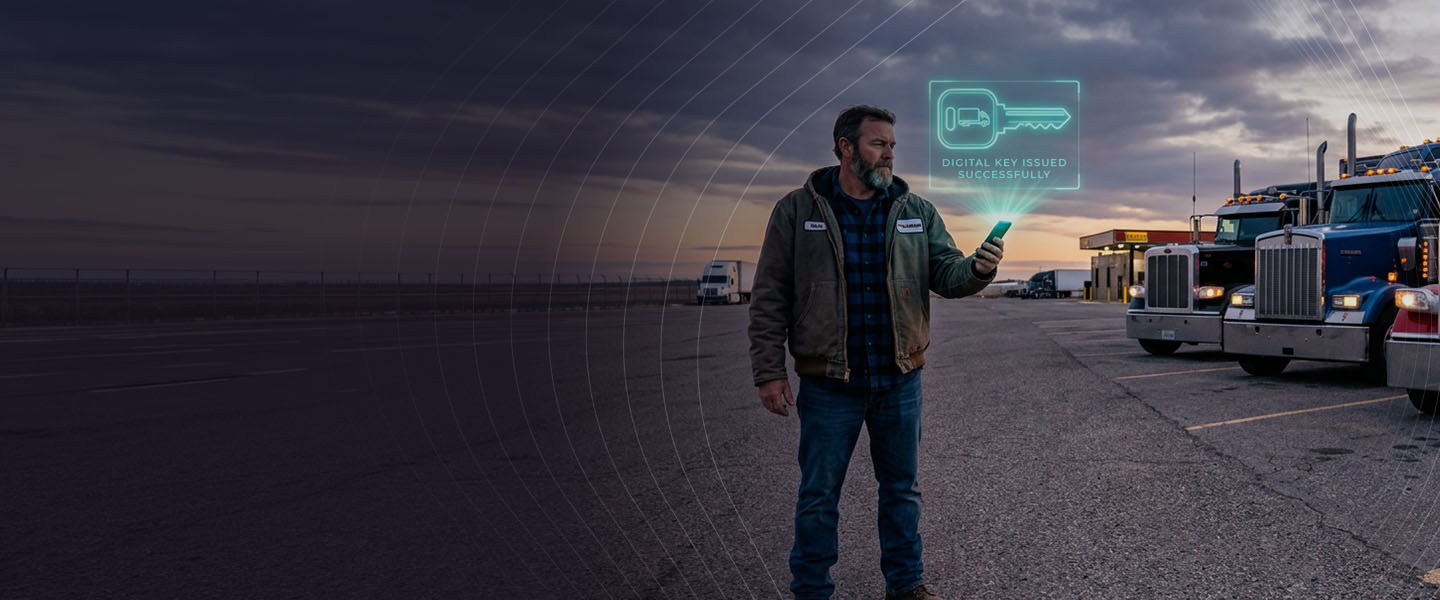
As delivery networks scale and diversify, physical key handoffs, unclear access ownership and lack of visibility into who is operating which vehicle can create delays, inefficiencies and security risks.
Keystone by Irdeto addresses that specific problem by digitizing vehicle access and providing a clear, auditable layer of control. This helps operators reduce friction in multi-driver operations and vehicle handoffs, while improving visibility and accountability across the network. Once access is digital, drivers get on the road faster, vehicle turnarounds happen more smoothly and security is baked in.
It is not the only lever that matters, but it is increasingly foundational as delivery operations become more dynamic.
Continuing the conversation
Home Delivery World reinforced a clear message: the industry is moving beyond speed as the primary differentiator. Operational consistency, efficiency and control are becoming just as important.
We are continuing to track how these trends evolve across different fleet types and delivery models.
If these challenges sound familiar, or if you are looking at how to manage access and control across a growing delivery network, reach out to Keystone by Irdeto to continue the conversation.




/Images/Module%20-%20footer/spiral.svg)


